


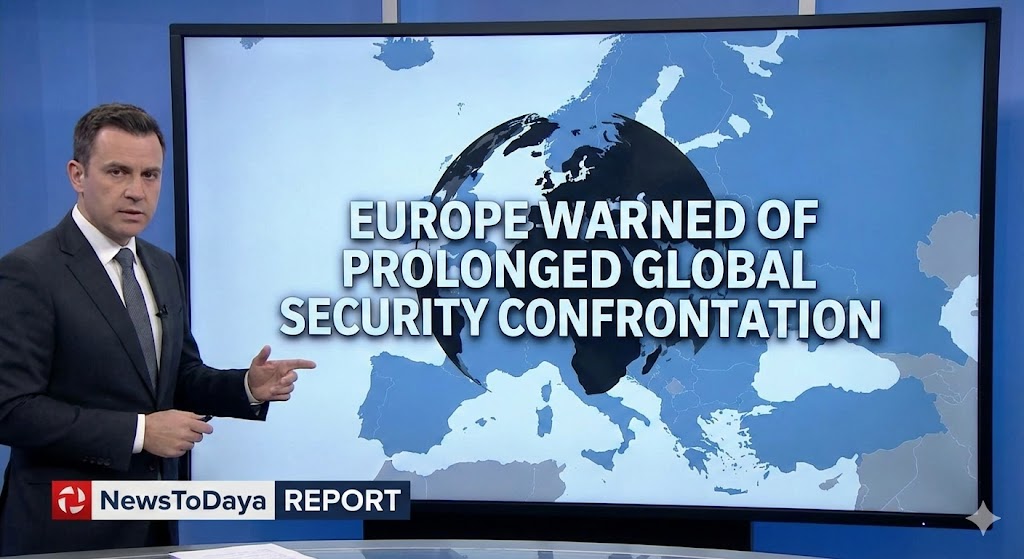
Europe is entering a phase of heightened uncertainty as policymakers, defense analysts, and international institutions increasingly warn of a prolonged global security confrontation. What was once viewed as a temporary period of instability is now being described as a long-term structural shift in global politics, military strategy, and economic security. The implications for Europe are profound, touching everything from defense spending and energy security to diplomacy, trade, and the everyday lives of citizens.
Over the past decade, Europe benefited from a relatively predictable security environment shaped by international cooperation and economic interdependence. That framework is now under pressure. Rising geopolitical rivalries, renewed great-power competition, and the erosion of long-standing norms have created a more volatile world. European leaders are being forced to rethink assumptions that guided policy since the end of the Cold War.
A Changing Global Security Landscape
At the heart of these warnings is the recognition that global power dynamics have shifted. Strategic competition is no longer confined to isolated regions but spans continents, domains, and technologies. Military, cyber, economic, and informational tools are now used simultaneously, blurring the line between peace and conflict.
Europe finds itself at the center of this evolving landscape. Its geographic position, economic influence, and political alliances make it both a key actor and a potential target in prolonged global tensions. Security officials increasingly describe the situation not as a single crisis, but as an era defined by persistent confrontation, where periods of calm are punctuated by sudden escalations.
This environment places sustained pressure on European governments to remain vigilant over long periods, rather than responding to short-term emergencies.
The Return of Strategic Rivalries
One of the most significant drivers of concern is the return of strategic rivalry between major global powers. Europe’s eastern borders remain sensitive, while tensions in the Middle East, the Indo-Pacific, and other regions continue to have direct and indirect effects on European security.
Competition between the European Union and external powers is no longer limited to military matters. It increasingly involves control over supply chains, access to critical technologies, influence over international institutions, and the ability to shape global narratives. These rivalries are expected to persist for years, if not decades.
For Europe, this means adapting to a world where strategic patience and long-term resilience are just as important as immediate deterrence.
Defense Spending And Military Readiness
Warnings about prolonged confrontation have already translated into policy changes. Many European countries are increasing defense budgets, modernizing armed forces, and strengthening collective defense mechanisms. Investments are being directed toward advanced capabilities such as air defense, cyber security, intelligence sharing, and rapid deployment forces.
The role of alliances has also grown in importance. Organizations such as NATO are undergoing strategic reassessments to ensure they remain effective in an era of hybrid threats and multi-domain conflict. European nations are being encouraged to take greater responsibility for their own security while maintaining strong transatlantic ties.
However, sustaining higher levels of defense readiness over long periods presents economic and political challenges. Governments must balance military needs with social spending, infrastructure investment, and climate goals.
Economic Security And Strategic Autonomy
Security concerns are no longer limited to the battlefield. European leaders increasingly view economic resilience as a core component of national and regional security. Dependence on external suppliers for energy, raw materials, and advanced technologies has been identified as a vulnerability that could be exploited during prolonged global confrontation.
As a result, Europe is pursuing strategies aimed at diversifying supply chains, investing in domestic production, and strengthening partnerships with trusted countries. Trade policy, industrial policy, and security policy are becoming more closely linked.
These shifts may lead to higher costs in the short term, but supporters argue they are necessary to protect Europe’s long-term stability and strategic autonomy in an unpredictable world.
Cyber Threats And Information Warfare
Another defining feature of the current security environment is the rise of cyber threats and information warfare. Europe has seen increasing attempts to disrupt critical infrastructure, influence public opinion, and undermine trust in democratic institutions through digital means.
Unlike traditional military threats, cyber and information attacks can occur continuously, below the threshold of armed conflict. This makes them particularly well-suited to a prolonged confrontation strategy, where pressure is applied steadily over time.
European governments are investing in cyber defenses, counter-disinformation initiatives, and public awareness campaigns. However, the challenge remains complex, as technological innovation often moves faster than regulation and policy.
The Impact On European Society
A prolonged global security confrontation does not only affect governments and militaries; it has tangible consequences for European societies. Higher defense spending can influence national budgets. Energy and trade disruptions can affect prices and employment. Persistent security concerns can shape public debate and political priorities.
At the same time, European citizens are being asked to adapt to a new reality where uncertainty is more common. Building societal resilience, maintaining democratic values, and preventing polarization are now viewed as essential elements of security policy.
Leaders stress the importance of transparency and communication, ensuring that citizens understand why certain policy choices are being made and how they contribute to long-term stability.
Diplomatic Challenges And Opportunities
Despite the focus on confrontation, diplomacy remains a critical tool for managing long-term security risks. Europe continues to support dialogue, arms control, and confidence-building measures where possible. Maintaining channels of communication, even during periods of tension, is seen as vital to preventing miscalculation and escalation.
Relations with major powers such as the United States and Russia remain central to Europe’s security outlook. While disagreements persist, engagement is often necessary to address global challenges that cannot be solved by confrontation alone.
Europe’s ability to act as a diplomatic bridge, promoting multilateral solutions and international law, is frequently highlighted as one of its strategic strengths.
Preparing For A Long-Term Reality
The growing consensus among analysts is that Europe must prepare for a long-term security environment defined by competition rather than cooperation. This does not mean abandoning dialogue or international norms, but it does require realism about the challenges ahead.
Preparation involves investing in defense and resilience, strengthening alliances, protecting democratic institutions, and ensuring economic stability. It also means cultivating unity among European states, as divisions could weaken collective responses during prolonged periods of pressure.
Conclusion
Warnings that Europe faces a prolonged global security confrontation reflect a broader understanding that the world has entered a new phase of international relations. The challenges are complex, interconnected, and unlikely to disappear quickly. How Europe responds in the coming years will shape not only its own security, but also the future of the global order.
As these developments continue to unfold, NewsToDaya will closely follow the policies, debates, and decisions shaping Europe’s security landscape. In an era of sustained uncertainty, informed analysis and global perspective remain essential, and NewsToDaya is committed to bringing readers clear insights into the forces redefining international security.