


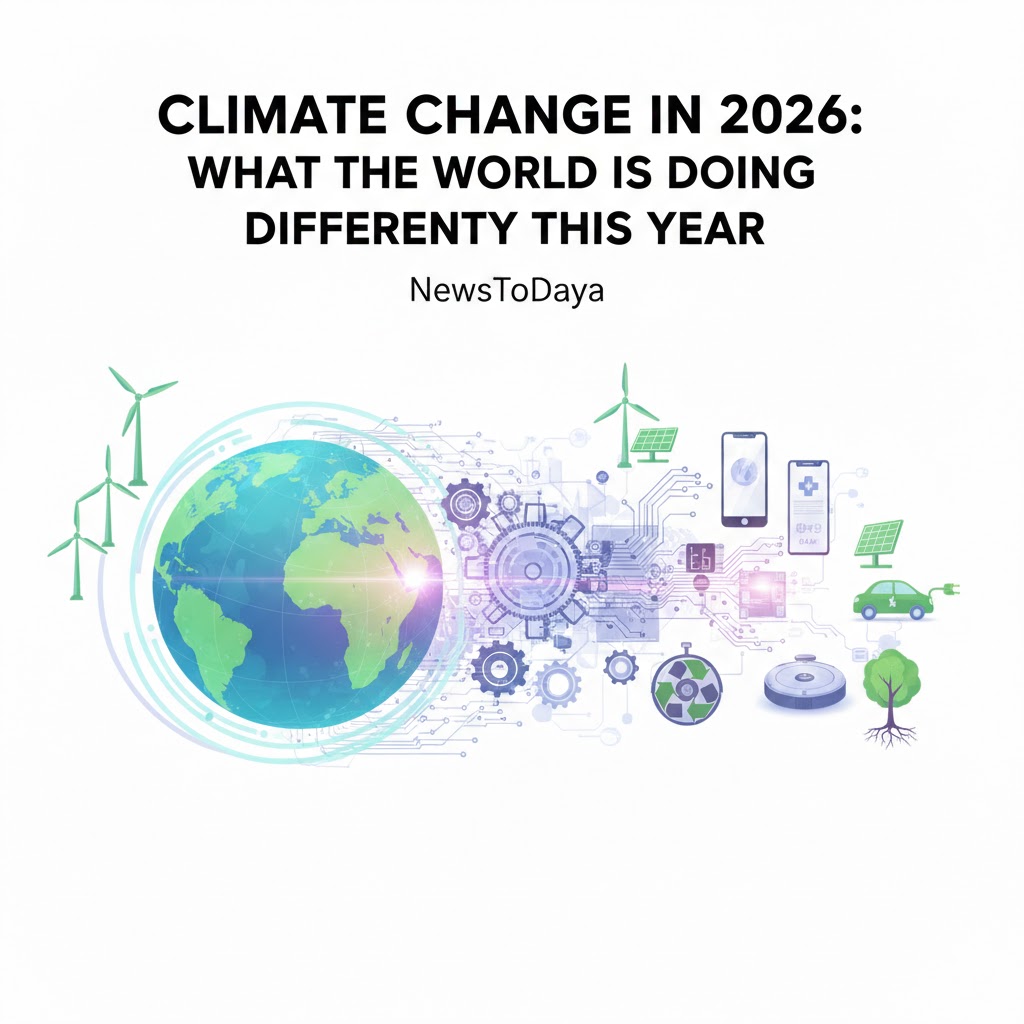
Climate change is no longer a distant concern or a future warning. In 2026, it has become one of the most urgent global realities shaping politics, economies, technology, and everyday life. Unlike previous years, the world is no longer just discussing climate targets and pledges. This year marks a clear shift toward visible action, accountability, and innovation. Governments, corporations, communities, and individuals are approaching climate change differently than ever before, driven by stronger public pressure, scientific urgency, and economic necessity.
At NewsToDaya, we track global shifts that define our future, and climate action in 2026 is one of the most significant transformations happening worldwide.
A Stronger Sense of Urgency Across Nations
One of the biggest changes in 2026 is how governments perceive climate risks. Extreme weather events have intensified across continents, including record-breaking heatwaves, floods, wildfires, and rising sea levels. These events are no longer isolated disasters; they are directly linked to climate patterns, forcing leaders to move beyond symbolic commitments.
Countries that once delayed climate action are now facing economic losses, displacement of populations, and infrastructure damage. As a result, climate planning has become central to national security strategies and economic policies. Climate ministries now work alongside finance and defense departments, highlighting how deeply climate change is influencing governance.
From Long-Term Promises to Short-Term Action
In earlier years, climate plans focused heavily on 2030, 2040, or 2050 goals. In 2026, the focus has shifted to immediate impact. Governments are setting short-term benchmarks, measuring progress annually rather than decades ahead. This change is pushing faster implementation of renewable energy projects, emission cuts, and conservation policies.
International climate frameworks shaped by the United Nations are now demanding transparent reporting and stricter accountability. Climate agreements are being tied to trade benefits, funding access, and diplomatic cooperation, making climate action a practical necessity rather than a moral obligation.
Renewable Energy Expansion at Record Speed
Renewable energy growth in 2026 is happening faster than analysts predicted. Solar, wind, and hydro projects are expanding not only in developed countries but also across emerging economies. What’s different this year is affordability and accessibility. Advances in energy storage, battery technology, and decentralized power systems have made renewables a realistic option even for remote regions.
Several nations are redesigning urban power grids to reduce dependence on fossil fuels while rural areas are benefiting from community-based renewable projects. This shift is also creating jobs, which has helped climate policies gain public support. Clean energy is now seen not just as an environmental solution but as an economic growth engine.
Corporate Climate Accountability Is Increasing
Another major change in 2026 is the pressure on corporations to prove real environmental impact. Greenwashing, once common, is now being exposed through stricter regulations and independent climate audits. Many multinational companies are legally required to disclose their carbon footprints, supply chain emissions, and sustainability efforts.
Climate-related financial risk reporting has become standard practice in global markets. Investors are prioritizing companies with strong environmental strategies, and businesses that ignore climate responsibility are losing trust and capital. This shift is forcing companies to invest in cleaner production methods, sustainable packaging, and carbon reduction technologies.
Climate Finance Reaches Local Communities
Climate finance in 2026 is no longer limited to large-scale international projects. A growing portion of funding is reaching local governments, indigenous communities, and grassroots organizations. This is a crucial change, as local communities are often the first to experience climate impacts and the most effective at implementing practical solutions.
Global financial institutions and climate funds are simplifying access to grants and low-interest loans, allowing smaller regions to invest in flood defenses, drought-resistant agriculture, and clean water systems. The focus has moved from centralized planning to community-driven climate resilience.
Technology Plays a Bigger Role Than Ever
Technology is transforming how the world responds to climate change in 2026. Artificial intelligence, satellite monitoring, and data analytics are being used to track deforestation, predict extreme weather, and optimize energy usage. Real-time climate data is helping governments respond faster to disasters and plan infrastructure more effectively.
Smart cities are using technology to reduce emissions through efficient transportation systems, intelligent energy management, and sustainable urban design. Even agriculture is evolving, with climate-smart farming techniques helping farmers adapt to unpredictable weather patterns.
Youth and Public Movements Gain More Influence
Public awareness and activism are stronger in 2026, especially among younger generations. Climate education is now part of school curricula in many countries, creating a generation that understands both the science and the solutions. Youth-led climate movements have matured into policy-focused organizations that engage directly with lawmakers and institutions.
Social media and digital platforms continue to amplify climate voices, making it harder for governments and corporations to ignore public demand. Climate justice, equity, and inclusion are central themes, emphasizing that vulnerable populations must not bear the greatest burden of environmental damage.
Adaptation Becomes as Important as Prevention
While reducing emissions remains critical, 2026 has made it clear that adaptation is equally important. Many regions are already facing irreversible climate impacts, and governments are investing heavily in resilience planning. Coastal defenses, heat-resistant infrastructure, water management systems, and disaster preparedness programs are expanding worldwide.
Urban planning now considers rising temperatures and extreme weather as standard factors. Cities are increasing green spaces, improving drainage systems, and redesigning buildings to withstand climate stress. This shift reflects a more realistic understanding of climate change as an ongoing challenge, not a future scenario.
Global Cooperation Looks More Practical
International climate cooperation in 2026 is more action-oriented than symbolic. Instead of lengthy declarations, countries are collaborating on shared technologies, cross-border renewable projects, and joint disaster response systems. Climate diplomacy has become a core part of international relations, influencing trade agreements and development partnerships.
Forums influenced by frameworks such as the Paris Agreement continue to guide global efforts, but with stronger enforcement mechanisms and clearer expectations. Climate leadership is now measured by results, not speeches.
A Defining Year for the Planet
Climate change in 2026 represents a turning point. The world is no longer debating whether climate action is necessary; it is figuring out how fast and how effectively it can act. While challenges remain, the shift toward accountability, innovation, and inclusion signals real progress.
The actions taken this year will shape environmental stability, economic resilience, and quality of life for generations to come. Climate change is no longer just an environmental issue; it is a defining force of global development.
At NewsToDaya, we believe that understanding these shifts is essential for navigating the future. Climate change in 2026 is not just about what the world is doing differently—it’s about recognizing that the future is being decided right now.