


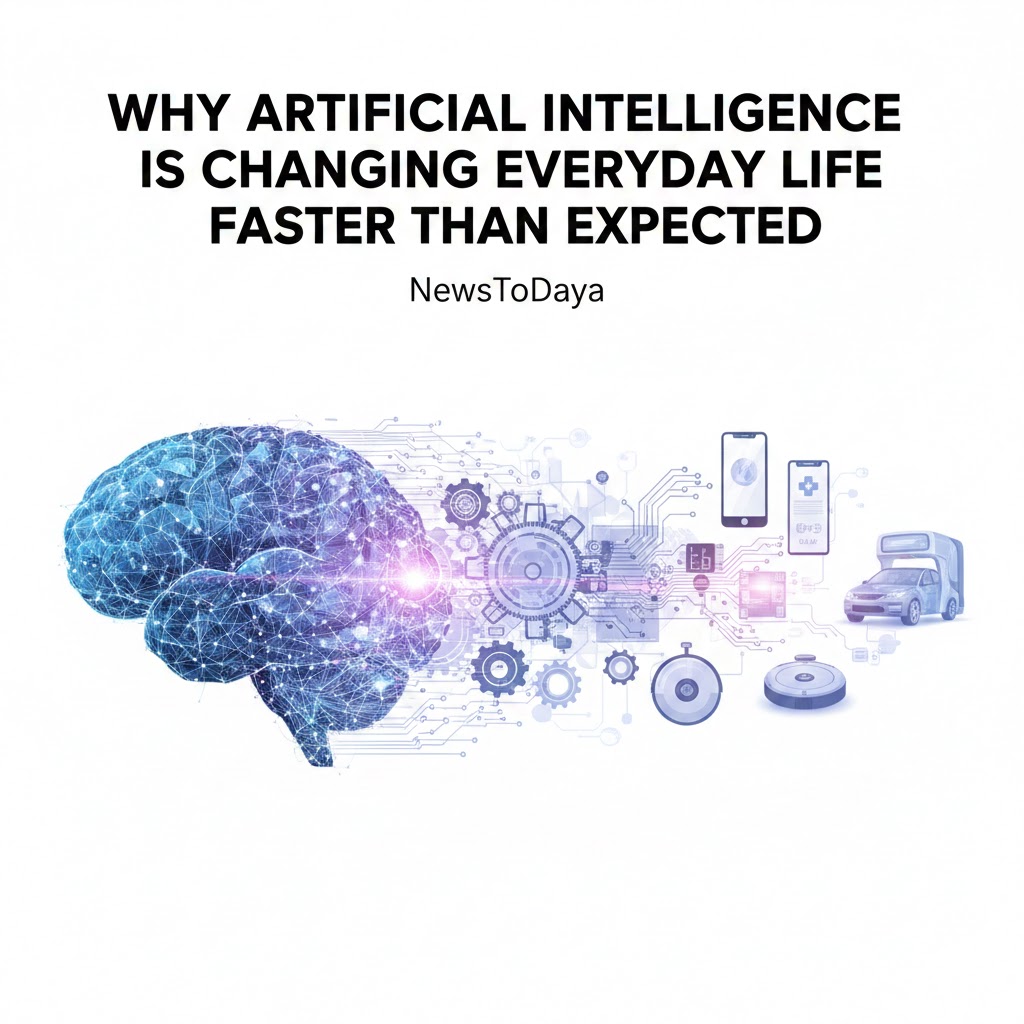
Artificial Intelligence (AI) is no longer a distant future concept—it is already embedded into daily life in ways most people never imagined would happen so quickly. From smartphones and healthcare to education, finance, and entertainment, AI is transforming how humans work, communicate, and make decisions. What makes this transformation surprising is not just the scale, but the speed at which it is happening.
At NewsToDaya, we track global innovations closely, and one thing is clear: Artificial Intelligence has moved beyond laboratories and tech giants into homes, offices, and even personal habits faster than any previous technological revolution.
The Rapid Evolution of Artificial Intelligence
Historically, major technological shifts—such as electricity, the internet, or smartphones—took decades to become part of everyday routines. Artificial Intelligence, however, has followed a much faster curve. Advances in computing power, cloud infrastructure, and access to massive data sets have accelerated AI development dramatically.
Machine learning models that once required years of research can now be trained in weeks. Open-source frameworks and global collaboration have allowed AI innovation to spread across borders almost instantly. As a result, businesses and consumers adopted AI tools at record-breaking speeds.
Another key reason for this rapid evolution is accessibility. AI tools are no longer limited to engineers or researchers. Today, anyone with a smartphone or internet connection is using AI—often without even realizing it.
AI in Everyday Consumer Technology
One of the most visible ways AI has changed daily life is through consumer technology. Smartphones use AI for facial recognition, voice assistants, photo enhancement, and battery optimization. Streaming platforms recommend movies and music using AI-powered algorithms that learn user preferences in real time.
Smart home devices rely on AI to adjust lighting, temperature, and security based on user behavior. Even simple actions like typing messages involve AI-driven predictive text and grammar correction.
What makes this shift faster than expected is how seamlessly AI blends into routine activities. People don’t “switch on” AI—they simply experience smarter, faster, and more personalized technology as the new normal.
Healthcare Transformation Through AI
Healthcare is one of the most impactful areas where AI is reshaping everyday life. AI-powered tools now assist doctors in diagnosing diseases earlier and more accurately. Imaging systems can detect abnormalities in X-rays and MRIs faster than human specialists in some cases.
Wearable devices use AI to monitor heart rate, sleep patterns, and physical activity, helping individuals take control of their health. AI-driven chat systems provide instant health guidance and symptom analysis, reducing the burden on hospitals and clinics.
The speed of adoption in healthcare surprised many experts. What once required years of clinical trials and manual processes is now supported by intelligent systems that continuously learn and improve.
Artificial Intelligence in Education
Education has undergone a silent but powerful AI-driven transformation. Online learning platforms use AI to personalize lessons based on student performance. Virtual tutors adapt teaching styles to match individual learning speeds, making education more inclusive and effective.
AI-powered language translation tools have broken down barriers, allowing students worldwide to access global educational content. Automated grading systems save teachers time, enabling them to focus more on student engagement and creativity.
The global shift toward digital learning—accelerated by world events—created the perfect environment for AI adoption in education. This rapid integration explains why AI’s impact feels sudden but deeply rooted.
AI and the Future of Work
Workplaces across industries are being reshaped by Artificial Intelligence. Automation tools handle repetitive tasks, freeing employees to focus on strategic and creative work. AI assists in recruitment, analyzing resumes and predicting job performance more efficiently than traditional methods.
Remote work tools powered by AI improve productivity through smart scheduling, task prioritization, and performance analysis. Small businesses now access AI-powered marketing, design, and analytics tools that were once available only to large corporations.
The speed of this workplace transformation is unprecedented. Instead of replacing humans entirely, AI has become a collaborative partner, enhancing human capabilities rather than eliminating them.
Transportation and Smart Mobility
Transportation is another area where AI is changing daily life faster than expected. Navigation apps use AI to predict traffic patterns and suggest optimal routes in real time. Ride-sharing platforms rely on AI for pricing, driver allocation, and safety monitoring.
Public transportation systems use AI to manage schedules, reduce delays, and improve passenger experience. Advanced driver-assistance systems in modern vehicles use AI to enhance road safety through automatic braking, lane detection, and collision warnings.
While fully autonomous vehicles are still evolving, AI-driven transportation solutions are already reshaping how people commute and travel every day.
Artificial Intelligence in Finance and Shopping
Financial services have embraced AI at remarkable speed. Fraud detection systems analyze millions of transactions instantly, protecting users from cybercrime. AI-powered budgeting apps help individuals manage expenses and plan savings more effectively.
In online shopping, AI predicts consumer preferences, recommends products, and optimizes supply chains. Dynamic pricing models adjust costs based on demand, location, and behavior, creating highly personalized shopping experiences.
This level of personalization—once considered futuristic—has become standard in just a few years, highlighting how quickly AI has transformed global commerce.
Social Media and Digital Communication
Social media platforms heavily rely on AI to curate content, filter harmful material, and personalize feeds. AI algorithms decide what users see, shaping opinions, trends, and digital culture worldwide.
Content moderation tools powered by AI help detect misinformation, spam, and inappropriate material at scale. AI-generated content, including images and videos, is also changing how people create and consume digital media.
The influence of AI on communication is profound, affecting how news spreads, how communities form, and how individuals express themselves online.
Ethical Concerns and Challenges
Despite its benefits, the rapid expansion of Artificial Intelligence raises ethical concerns. Issues related to data privacy, algorithmic bias, and job displacement continue to spark global debate. The speed of AI adoption has outpaced regulatory frameworks in many regions.
Governments and organizations are now racing to establish ethical guidelines and policies to ensure responsible AI use. Transparency, accountability, and fairness have become central themes in discussions about AI’s future.
These challenges highlight that while AI’s growth is impressive, careful oversight is essential to prevent unintended consequences.
Why the Change Feels Faster Than Ever
Several factors explain why Artificial Intelligence is changing everyday life faster than expected. First, digital infrastructure is already widespread, allowing AI tools to scale instantly. Second, global connectivity enables rapid sharing of innovations across borders. Third, AI systems improve continuously through data, accelerating their effectiveness over time.
Unlike previous technologies, AI doesn’t just add new tools—it enhances existing systems. This compounding effect makes progress feel exponential rather than linear.
The Road Ahead
Artificial Intelligence will continue to integrate deeper into daily life, influencing decisions, habits, and industries worldwide. Future developments may bring even more personalized healthcare, smarter cities, and more adaptive education systems.
At NewsToDaya, we believe understanding AI’s rapid growth is essential for navigating the modern world. The faster people adapt and learn, the better prepared they will be to benefit from this transformative technology.
Final Thoughts
Artificial Intelligence is not changing the future—it is changing the present. Its influence on everyday life has arrived faster than expected because it builds on existing digital foundations and evolves at unprecedented speed. From healthcare and education to work and communication, AI has become an invisible yet powerful force shaping how the world operates.
As this transformation continues, staying informed and adaptable will be the key to thriving in an AI-driven world—and NewsToDaya will continue bringing insights into how global innovations shape everyday life.